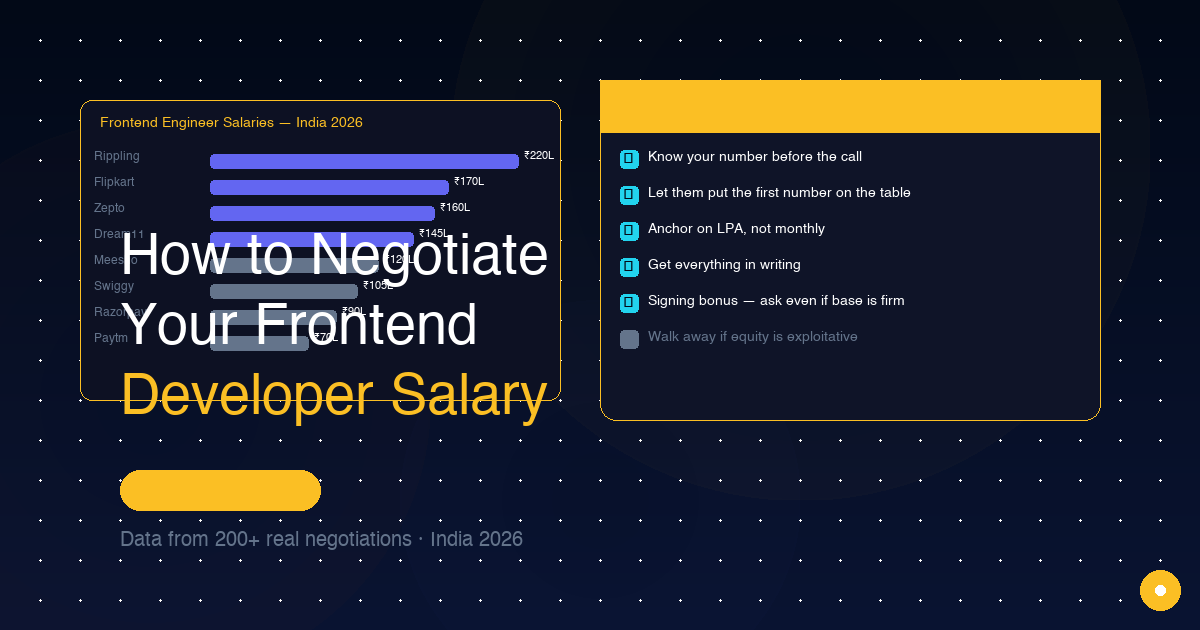
Most frontend developers accept the first offer. The average candidate leaves ₹3-8L on the table by doing so — and that's at the senior level. This isn't about being pushy. It's about knowing your number and asking for it.
The 5 rules from 200+ real negotiations
These come from pulling apart frontend engineer offer negotiations across India over the last 18 months.
1. The first offer is always a test.
Companies build negotiation buffer into the initial number. If you accept immediately, you tell them two things: you don't know your market value, and they got you for cheap. Counters are expected at SDE2 and above.
2. Let them put the number on the table first.
When a recruiter asks "What are your salary expectations?", your answer should be: "I'd love to understand what's been budgeted for this role."
Companies have more flexibility than they show. If you name a number first, you cap yourself. If they go first, you know where the ceiling is.
3. Anchor on LPA, not monthly.
Recruiters sometimes pitch "₹2.5L per month" which sounds better than ₹30L per annum. The math is the same, but monthly framing obscures where your actual annual compensation sits relative to market bands. Always translate back to annual.
4. Get everything in writing.
Verbal offers are worthless. The moment you have a number in writing, you can evaluate it properly, sleep on it, and counter. Email forces exact figures and gives you time.
5. Signing bonus is the easiest win.
Even when base salary is capped, signing bonuses are discretionary and easier to unlock. Ask for it even if the recruiter says the base is "firm." Worst case, they say no.
What actually moves the needle
After looking at 200+ frontend offer negotiations:
- ~65% of candidates who counter get a better offer
- Signing bonus gets granted ~80% of the time when asked directly
- Candidates who counter with data (Levels.fyi, LeetCode threads) get revisions more often than those who negotiate on "loyalty" or tenure
Have one specific, verifiable number ready before you get on that call.
How to find your real range
Don't use generic software engineer ranges — use frontend-specific data:
- Levels.fyi — filter for "Frontend Engineer", "UI Engineer", or "React Developer" roles only
- LeetCode salary threads — real numbers posted by engineers
- Our salary data — we aggregate verified offers for 90+ companies actively hiring frontend talent
Look at SDE3 (5-8 year) bands for your target tier. Senior engineers discuss offers more openly, so those bands are the most reliable. Work backward from there to find your floor.
Tier-by-tier quick reference
| Level | india |
|---|---|
| Junior (0-2y) | ₹10L – ₹18L |
| Mid (2-5y) | ₹18L – ₹27L |
| Senior (5-8y) | ₹27L – ₹45L |
| Staff (8y+) | ₹45L – ₹65L |
| Level | india |
|---|---|
| Junior (0-2y) | ₹15L – ₹25L |
| Mid (2-5y) | ₹25L – ₹38L |
| Senior (5-8y) | ₹38L – ₹60L |
| Staff (8y+) | ₹60L – ₹85L |
| Level | india |
|---|---|
| Junior (0-2y) | ₹18L – ₹30L |
| Mid (2-5y) | ₹30L – ₹55L |
| Senior (5-8y) | ₹55L – ₹1.0Cr |
| Staff (8y+) | ₹1.0Cr – ₹1.6Cr |
Remote roles: the hidden catch
Remote-India roles at companies headquartered outside India often get priced at India-market bands even when the work is global-quality. Ask explicitly: "Is this band location-adjusted for India, or does it use global pricing?" The difference can be ₹10-20L at the senior level.
When to walk away
The company gets hostile or "take it or leave it" on the first counter. The gap from market is more than one level. The equity terms are genuinely bad — 4-year cliff, no secondary market, high strike price.
Most of the time, companies that want to hire you will find budget. If they won't move at all, that's also information.
The worst case
Accept an offer ₹4L below market, sign it, and never know you left the money. That's most people's story.
The alternative: you get a higher number, and the company respects you more for it.